
What’s going on with house spiders in autumn?
Halloween is the one time of year when we deliberately fill our homes with spiders. We hang fake cobwebs from ceilings, put plastic spiders on windowsills and decorate our doorsteps with all manner of creepy crawlies. But just as the Halloween decorations are going up, some rather more authentic eight-legged visitors start making their presence felt.
A large, hairy spider suddenly appearing on the sitting-room carpet can be quite a shock for many people. Particularly when it seems to move faster than anything that size has a right to!
But why do we see so many spiders in autumn? What are they doing in our houses, and should we really be frightened of them?
The truth is that these familiar autumn visitors have some fascinating lives of their own. And once you understand a little more about them, you might find yourself looking at them rather differently. After all, Halloween wouldn’t be quite the same without spiders!
Looking for love: why spiders appear in autumn
If you’ve noticed more spiders scurrying across your floors in September and October, you’re not imagining things. Autumn is an important time in the life cycle of many of our larger house spiders. The reason is surprisingly romantic: they’re looking for love!
During the summer, young spiders grow and mature, often living quietly in dark corners, behind furniture and in other sheltered places. As autumn arrives, mature males of several common house spider species leave their usual hiding places and go wandering in search of females.
This is why we suddenly seem to encounter so many of them. They’re not necessarily moving into our homes to escape the cold. Many have been there all along, quietly minding their own business. It’s just that the males are now out and about, looking for a mate. A male spider may travel across several rooms, climbing walls and dashing across floors. Some of our larger house spiders can move at astonishing speed, up to half a metre per second. So that spider making a sudden appearance in your bedroom might not be looking for somewhere to hide. He could simply be looking for a girlfriend.
Spider dating: it’s all about the right signals
Finding a mate is not quite as straightforward as you might imagine in the spider world. Female spiders tend to stay close to their webs, while males do most of the travelling. But approaching a female is a risky business. In some species, a female may mistake an approaching male for prey and eat him!
To avoid this unfortunate misunderstanding, male spiders have developed some rather elaborate courtship techniques. Depending on the species, they may tap their legs, drum on the web or send carefully timed vibrations through the silk. These signals help the female recognise that the visitor is a potential mate rather than a meal. If she responds positively, the pair may mate.
The secret lives of house spiders
Ireland is home to around 390 species of spider, although only a small number regularly make their homes indoors.
One of the most familiar is the giant house spider, a large, brown, long-legged spider that is particularly noticeable in autumn. Despite its intimidating appearance, it is generally a shy creature that prefers to stay out of our way.
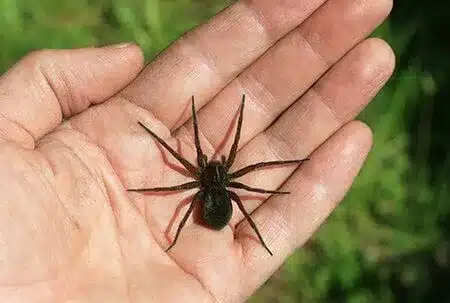
Many house spiders spend much of their time in a sheltered retreat, often behind furniture or in a quiet corner, waiting for insects to become caught in their webs. Their webs are remarkable pieces of natural engineering. Some house spiders make sheet-like webs, often with a funnel-shaped retreat where the spider can shelter and wait for passing prey. Others make tangled webs in corners and less disturbed parts of the house.
Spider silk is an extraordinary material: strong, flexible and produced by the spider itself. It can be used to build webs, wrap up prey and provide safety lines. And spiders are not just clever builders. They’re also useful little pest controllers. They feed on a variety of insects and other small invertebrates, including flies, moths and midges. Some house spiders even catch other spiders! They don’t eat our food or crumbs, but they do benefit from the insects that may be attracted to our homes. So that little web in the corner of the shed might be doing more useful work than you realise.
Why do they always seem to end up in the bath?
One of the classic autumn spider encounters is finding a large spider stranded in the bath or sink. This isn’t because spiders particularly enjoy bathrooms. It’s because smooth, slippery surfaces can be very difficult for some of them to climb. Once they’ve fallen in, they may struggle to get back out again.
A simple solution is to leave a small towel draped over the side of the bath or sink. This creates a little ramp that gives wandering spiders a chance to escape. It’s a small gesture, but a helpful one for a creature simply trying to get on with its day.
Friends, not foes
For anyone who feels uneasy around spiders, it’s worth remembering that the common house spiders we encounter are generally not interested in us at all. They don’t chase people, and they certainly aren’t waiting in dark corners to pounce on unsuspecting Halloween visitors. Most prefer to avoid human contact. Bites from common house spiders are uncommon, and serious reactions are very rare.
It’s still best not to handle unfamiliar spiders, however. If you find one indoors and would prefer it somewhere else, you can gently guide it into a glass or container, slide a piece of card underneath and move it to a sheltered place, such as a shed or garage.
And perhaps we can learn to be a little more tolerant of the webs we find in quieter corners of our homes. They are evidence of a small but important natural life happening alongside our own.
A little more wonder, a little less fright
Halloween gives us a wonderful opportunity to celebrate the creatures that we don’t always understand. But perhaps we can take the opportunity to look beyond the plastic spiders and fake cobwebs, and appreciate the real thing.
Spiders are skilled hunters, remarkable engineers and an important part of healthy ecosystems. They help keep insect populations in balance and provide food for other wildlife. They have their own fascinating ways of communicating, finding partners and raising the next generation.
We don’t all have to love having a spider in the bedroom. But we can learn to share our spaces with them, and recognise that they have an important place in the natural world.